
Milara GmbH
Booth number: 1444-05
www.milarasmt.com
About us
Milara has been specializing in semiconductor wafer handling robot manufacturing since its founding in 2001. Milara provides cutting-edge robotic solutions that emphasize precision, reliability, and cost-effectiveness. Our diverse product range includes wafer transfer robots, wafer prealigners, equipment front-end modules (EFEMs), sorters, and custom solutions, all critical for semiconductor wafer manufacturing and handling. Beyond manufacturing, we offer contract manufacturing, design and precision machining services across multiple industries, showcasing our versatility and commitment to quality and innovation.
Address
Am Söldnermoos 17
85399 Hallbergmoos
Germany
E-mail: sales@Milarasmt.com
Phone: +49 151 15839401
Internet: www.milarasmt.com
49 Maple Street
01757 Milford
United States
E-mail: sales@milarasmt.com
Phone: +1 508 533-5322
Internet: milarasmt.com/
3 Georgi Tringov str.
4003 Plovdiv
Bulgaria
E-mail: sales.bg@milaraint.com
Phone: +359 32 234100
Internet: milarainternational.com/
Contact person:
Helge Luesebrink
Sales Manager, Europe
E-mail: Helge.Luesebrink@milarasmt.com
Phone: +49 151 15839401
Marius Avram
Head of Global Sales
E-mail: marius.avram@milarasmt.com
Phone: +1 508 282-0507
Products & Services
Milara has a long history of developing automation designs serving the needs of the semiconductor, automotive, and medical industries. It is recognized as a leading international provider of wafer automation solutions for global top tier customers in USA, Europe, and Asia. The company`s portfolio includes but it is not limited to the design and manufacturing of high technology wafer handling tools such as Equipment Front End Modules (EFEM), Wafer Handlers, Sorters, Robots, Prealigners and many more. On top of that, Milara offers high precision CNC machining services, complex manufacturing automation solutions, and contract mechanical design. Milara’s long-standing experience in robotics and mechatronics can satisfy any customer requirement for production automation.
What stands as a competitive advantage for Milara is the vertically integrated production system which ensures tightly controlled production processes and uncompromised final product quality. Our team of skilled professionals is dedicated to delivering products and services which exceed client expectations. Milara's core values of determination, commitment, production quality, customer satisfaction, continuous improvement, and teamwork are the main engine of the company`s operations.
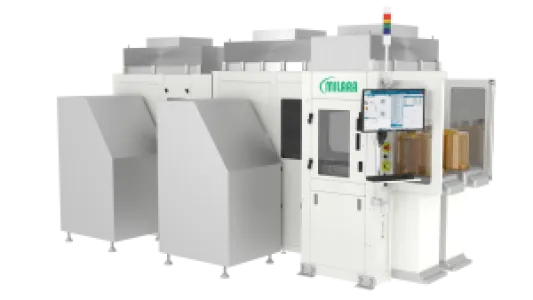
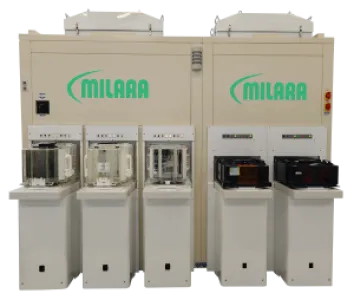
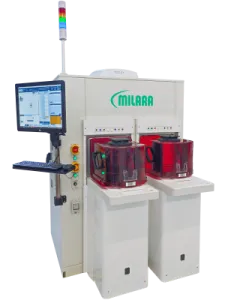
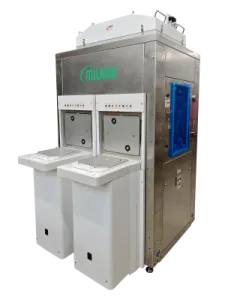
Milara EFEM
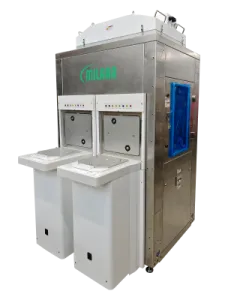
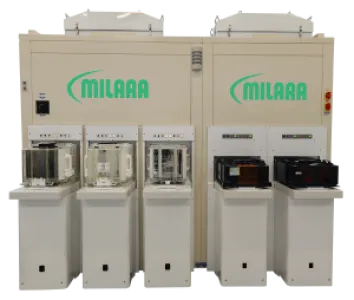
The Milara EFEM (Equipment Front End Module) is a system designed to maximize productivity of semiconductor processing equipment tools that require the highest level of automation. The Load Port is modular and can seamlessly integrate to the OEM process tools. Milara’s EFEM can be customized to meet the automation requirements of any semiconductor manufacturing facility, adding stations such as pre-aligners and OCR. Capable of handling various wafer sizes with 1-5 load ports or custom cassette holders. Milara’s Process and EFEM modules are built to customer specification to meet specific system and layout requirements. All components of the system are ISO 3 (ISO14644) / Class 1 (FED STD 209E) Clean room compliant and the optional fan filter unit built into the mini-environment can provide laminar flow for maximum cleanliness.
Highly customizable design for meeting all your production needs.
Modular design with vibration isolation, ensuring independence from any type of wafer processing, inspection and measurement.
One to five Load Port configuration and/or up to 24 open cassettes for 100mm-200mm wafers. EFEM can be configured as a “bridge tool” for FOUPs and open cassettes of various sizes.
Depending on the Load Port configuration, the Milara EFEM can handle 300mm wafers exclusively, Film-Frame substrates exclusively, or a combination of both.
Industry-standard SEMI BOLTS interface allows for mounting of load ports, process modules, measurement and other equipment.
Milara’s EFEM can include a Fan Filter Unit providing mini-environment laminar flow for maximum cleanliness.
Full line of autonomus Wafer Prealigners centering from 50mm to 300mm wafers with 20 microns accuracy or better
Through the wall or Ball Room mounting.
Optional SECS/GEM interface.
High-throughput and reliable Milara single or dual arm robot for fast wafer swapping.
OCR integrated within the prealigner module reliably track IDs on both sides of the substrate.
Option to integrate digital scale, measurement, or inspection equipment within the EFEM frame.
Variety of end effector options including vacuum gripping and edge gripping. End Effectors include integrated through-beam sensor for quick and reliable wafer mapping as well as reporting for: occupied slots, empty slots, and cross-slotted substrates.
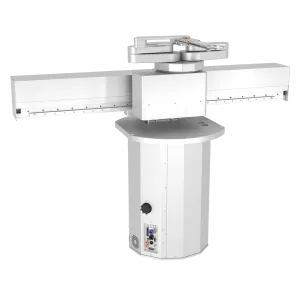
Clean Linear track with linear motors.
ISO 3 (ISO 14644) / Class 1 (FED STD 209E) Clean room compliant.
CE compliant.
Compliant with SEMI standards.
Reliability – MTBF > 60,000 hours, (MCBF > 10,000,000 cycles).
Monitor and Keyboard.
Wafer Flipping (optional).
Powder coat or stainless-steel finish.
Milara Wafer Handling Robots
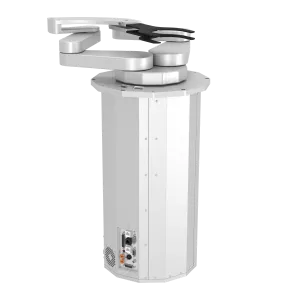
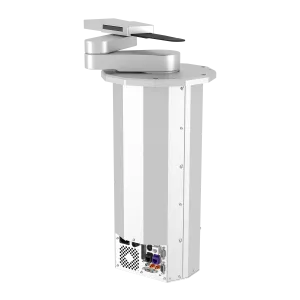
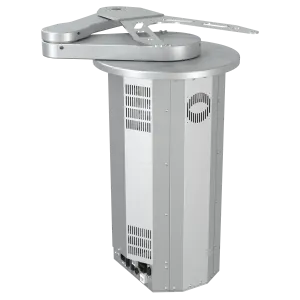
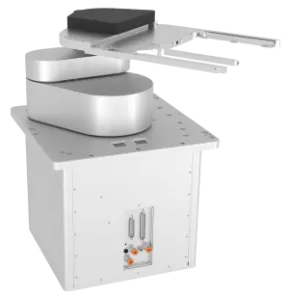
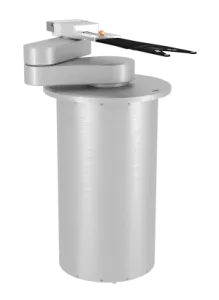
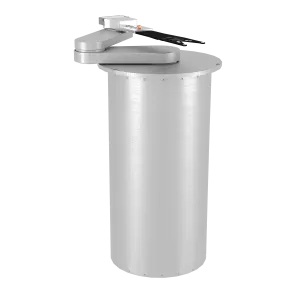
The H4 series atmospheric robots represent a significant engineering advancement in the design and reliability of wafer handling equipment.
Two independent arms (R1 and R2) attached to a common rotary axis (T) allow fast swapping or simultaneous transfer of two wafers.
Benefiting from technologically superior components, the robots utilize ultra low inertia, high-response brushless servomotors coupled with zero-backlash Harmonic Drive® gears to achieve greatly enhanced dexterity and precision.
The innovative, all-in-one, design incorporates the motion controller, servo amplifiers, and power supply within the robot’s industry standard footprint.
High-strength structural members enable top, bottom or side mount configurations without compromising the system rigidity.
A 32-bit, real-time kernel delivers accurate motion profiling along smooth continuous trajectories, while the distributed control architecture allows a seamless integration with linear tracks, pre-aligners, and other sub-components.
Networkable RS-485 and Ethernet interfaces complement the standard RS-232 and teach pendant connections. Powerful native wafer handling and scripting languages facilitate rapid software development for embedding the robots into an OEM application environment.
Comprehensive emulation of legacy robot “macro” commands offers a drop-in compatibility with a wide variety of existing semiconductor tools.
Excellent structural rigidity.
Modular and highly customizable design.
Arm length from 10.50” and 20”.
Vertical travel from 13 up to 22”.
Fully integrated motion controller, servo amplifiers and power supply.
High response brush-less motors and precise zero-backlash Harmonic Drive® gears Absolute encoders eliminating the initial homing procedure.
Handling radial and in-line equipment placement.
Seamless integration with prealigner, linear track and other peripheral components.
Standard RS-232 interface and Ethernet (Telnet) interfaces to the host computer.
Advance 32-bit real-time motion control kernel, Powerful wafer handling firmware.
Comprehensive software tools and utilities.
Software emulation for legacy robot macro commands, Optional teach pendant terminal.
General purpose digital inputs and outputs for custom use.
Reliability – MTBF > 60000 hours, (MCBF > 10,000,000 cycles)
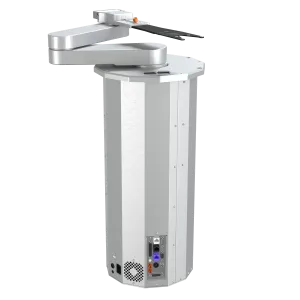
The H3 series atmospheric robots represent a significant engineering advancement in the design and reliability of wafer handling equipment.
Benefiting from technologically superior components, the robots utilize ultra low inertia, high-response brushless servomotors coupled with zero-backlash Harmonic Drive® gears to achieve greatly enhanced dexterity and precision.
The innovative, all-in-one design incorporates the motion controller, servo amplifiers, and power supply within the robot’s industry standard footprint.
High-strength structural members enable top, bottom or side mount configurations without compromising the system rigidity.
A 32-bit, real-time kernel delivers accurate motion profiling along smooth continuous trajectories, while the distributed control architecture allows a seamless integration with linear tracks, pre-aligners, and other sub-components.
Networkable RS-485 and Ethernet interfaces complement the standard RS-232 and teach pendant connections. Powerful native wafer handling and scripting languages facilitate rapid software development for embedding the robots into an OEM application environment.
Comprehensive emulation of legacy robot “macro” commands offers a drop-in compatibility with a wide variety of existing semiconductor tools.
Excellent structural rigidity
Modular and highly customizable design
Arm length from 10.50” up to 23.62”
Vertical travel from 13″ up to 22”
Fully integrated motion controller, servo amplifiers and power supply
High response brushless motors and precise zero-backlash
Harmonic Drive® gears
Optional absolute encoders eliminating the initial homing procedure
Handling radial and in-line equipment placement
Seamless integration with prealigner, linear track and other peripheral components
Standard RS-232 interface and Ethernet (Telnet) interfaces to the host computer
Advance 32-bit real-time motion control kernel
Powerful wafer handling firmware
Comprehensive software tools and utilities
Software emulation for legacy robot macro commands
Optional teach pendant terminal
General purpose digital inputs and outputs for custom use
Reliability – MTBF > 60,000 hours, (MCBF > 10,000,000 cycles)
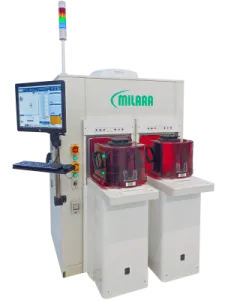
Milara Smart Prealigners
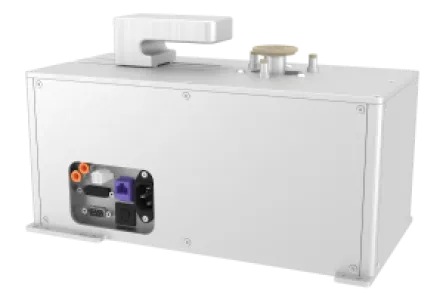
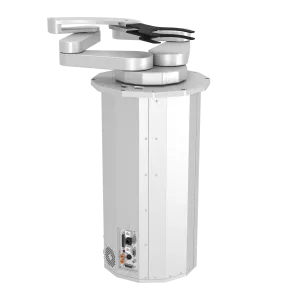
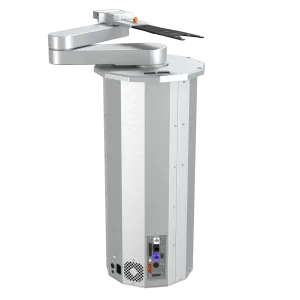
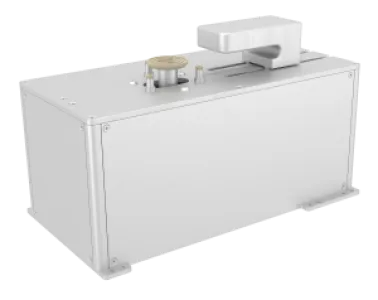
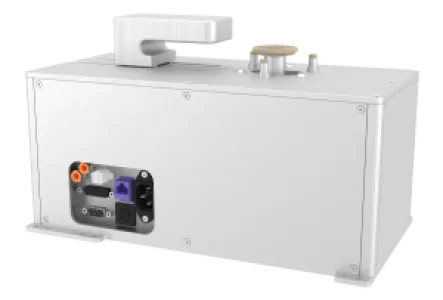
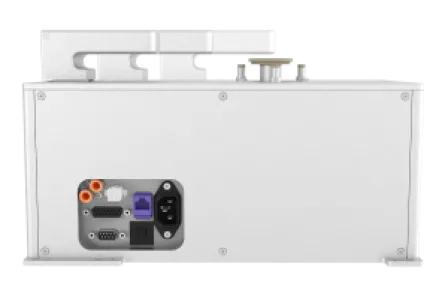
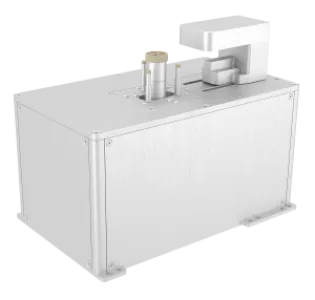
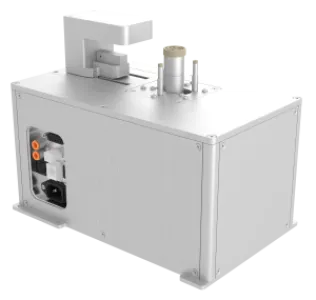
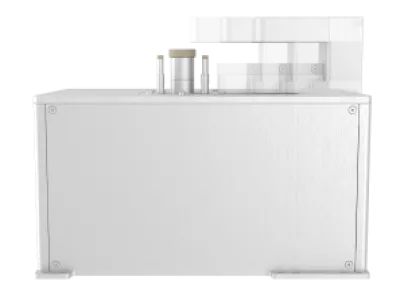
Milara Smart Prealigner offers industry leading alignment precision using a high-resolution encoder. The aligner unit features RGB and IR light sources allowing easier and faster edge detection for semi-transparent and glass carriers. The moving lighthouse allows alignment of square and round substrates with non-standard sizes. Milara Smart Prealigner is equipped with with self-calibration and self-diagnostic capabilities. A web interface with M2M communication capability for smart manufacturing and automation is at your disposal. Wide variety of Chuck and Pin materials are available – Peek, Tekapeek ELS nano, Semitron ESD420, Viton, Kalrez, Ceramic, etc.
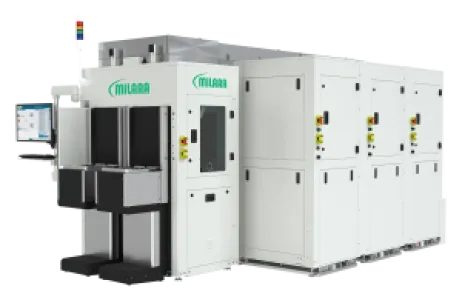
Milara Wafer Sorters
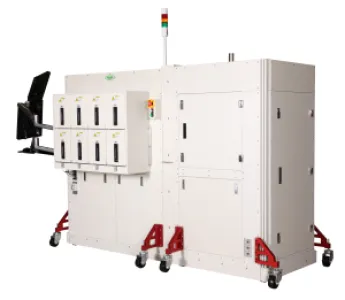
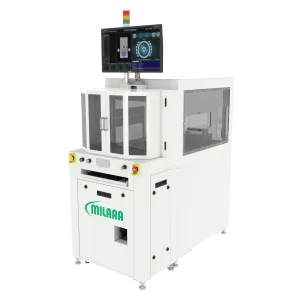
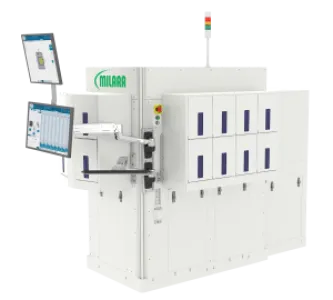
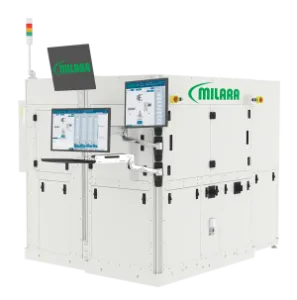
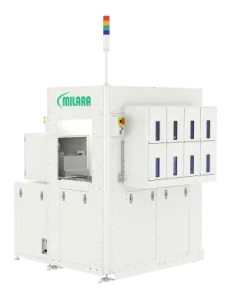
The latest generation high-throughput wafer sorting platform from Milara Inc. It brings to market innovative and fully automated cassette stations, which provide a complete system from the loading of new substrates through the unloading of processed substrates without interrupting the robot cycle. This enables unparalleled processing throughput of more than 220 wafers per hour. A modular design allows for the processing of up to 20 carriers simultaneously and central to the system is Milara’s Diamond H4 dual-arm robot for rapid wafer swapping. End effectors on the robot include integrated through-beam sensors for quick and reliable wafer mapping, reporting occupied or empty slots, and identifying cross-slotted substrates. Fully integrated precision wafer handling components include an autonomous pre-aligner to center wafers with 20 micron accuracy, an optical character reader to reliably track ID’s on both sides of the substrate, and high-precision digital scales capable of measuring a wafer in one half of a second with 1 milligram resolution. All components of the system are ISO 3 (ISO14644) / Class 1 (FED STD 209E) Clean room compliant and the optional fan filter unit built into the mini-environment can provide laminar flow for maximum cleanliness.
Milara HyperMation Cluster Tools
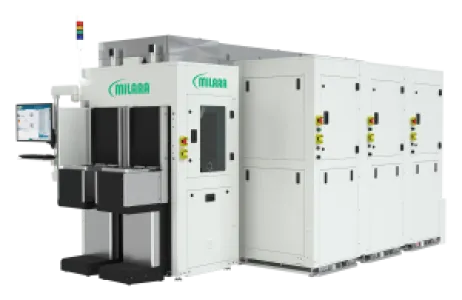
During time-controlled fix-process sequences, idle time pockets occur, often dictated by the slowest process step, impacting overall tool throughput. Solutions include buffer stations for wafer storage and multi gripper systems for efficient robot travel. Original Equipment Manufacturers (OEMs) seek shorter cycle times while maintaining precision standards. Milara's HyperMation features self-learning algorithms used in project phases via process simulation with digital twins of semiconductor equipment, optimizing layout, cycle times, and module compositions. The aim is to eliminate idle times and maximize module utilization, tailoring algorithms to each machine's unique layout and processes.